Size the gate for the widest, longest thing that will ever need to come down your driveway, not for the truck you drive today. That list almost always includes something bigger than a pickup: a gooseneck stock trailer, a hay truck, a gravel truck, a lowboy hauling a tractor, a well rig, a propane truck, and eventually a fire engine or an ambulance. The opening that feels generous when you’re driving a half-ton alone is the one that costs somebody a mirror at two in the morning.
The other half of the answer is that width alone doesn’t get a rig through a gate. The approach does.
Measure the widest load, then measure the turn
Start with an inventory instead of a number. Walk your operation and list every vehicle that has come, or will come, through the entrance — including the ones that show up once a decade. Then note two things about each: how wide it is at its widest point (mirrors, duals, a swather head, a wide bale bed) and how long it is from the front bumper to the back of the trailer.
Width tells you how big the opening has to be. Length tells you how much room the driver needs to swing into it. A long combination doesn’t drive through a gate — it tracks through, with the trailer wheels cutting inside the path of the truck. The tighter the turn off the road, the farther inside the trailer cuts, and the more opening you need to absorb that. A gate that’s comfortable on a straight-in approach can be genuinely hard to hit when the driveway turns sharply off a county road.
That’s why an honest answer to “how wide” always comes with a second question: how straight is the approach? Straighten the approach and you can often live with a narrower gate. Leave a hard turn in it and you need extra width, a wider flare where the driveway meets the road, or both. Shaping that approach is driveway and turnaround work as much as it is gate work, and it’s usually cheaper to move dirt once than to live with a pinch point forever.
Height counts too. If the plan includes an entrance archway, the clearance under it is permanent. Measure your tallest load — a loaded hay truck, an excavator on a trailer, a camper — and be generous, because the archway is the one part of an entrance nobody can adjust later.
Swing or slide in snow country
Both work in Montana. They fail differently, and the site usually picks one.
| Swing gate | Slide gate | |
|---|---|---|
| Room it needs | A clear arc on the swing side, kept free of snowbanks, plow windrows, and parked vehicles | Room alongside the opening for the gate to retract into, plus a clear track or cantilever path |
| Snow behavior | Blocked by whatever the plow piles in the arc; drifts stop it cold | Ground-track designs pack with ice, gravel, and grit; cantilever designs sidestep this by carrying no ground track |
| What it asks of the ground | Solid, stable hinge posts — any post movement changes the geometry and the gate drags or won’t latch | A level, stable run along the retract path; heave along that line binds the gate |
| Wind | Catches wind like a sail when open; needs a hold-back or a stop | Presents less area to wind while cycling |
| Repair | Simple hardware, easy to service | More moving parts, but no arc to keep clear |
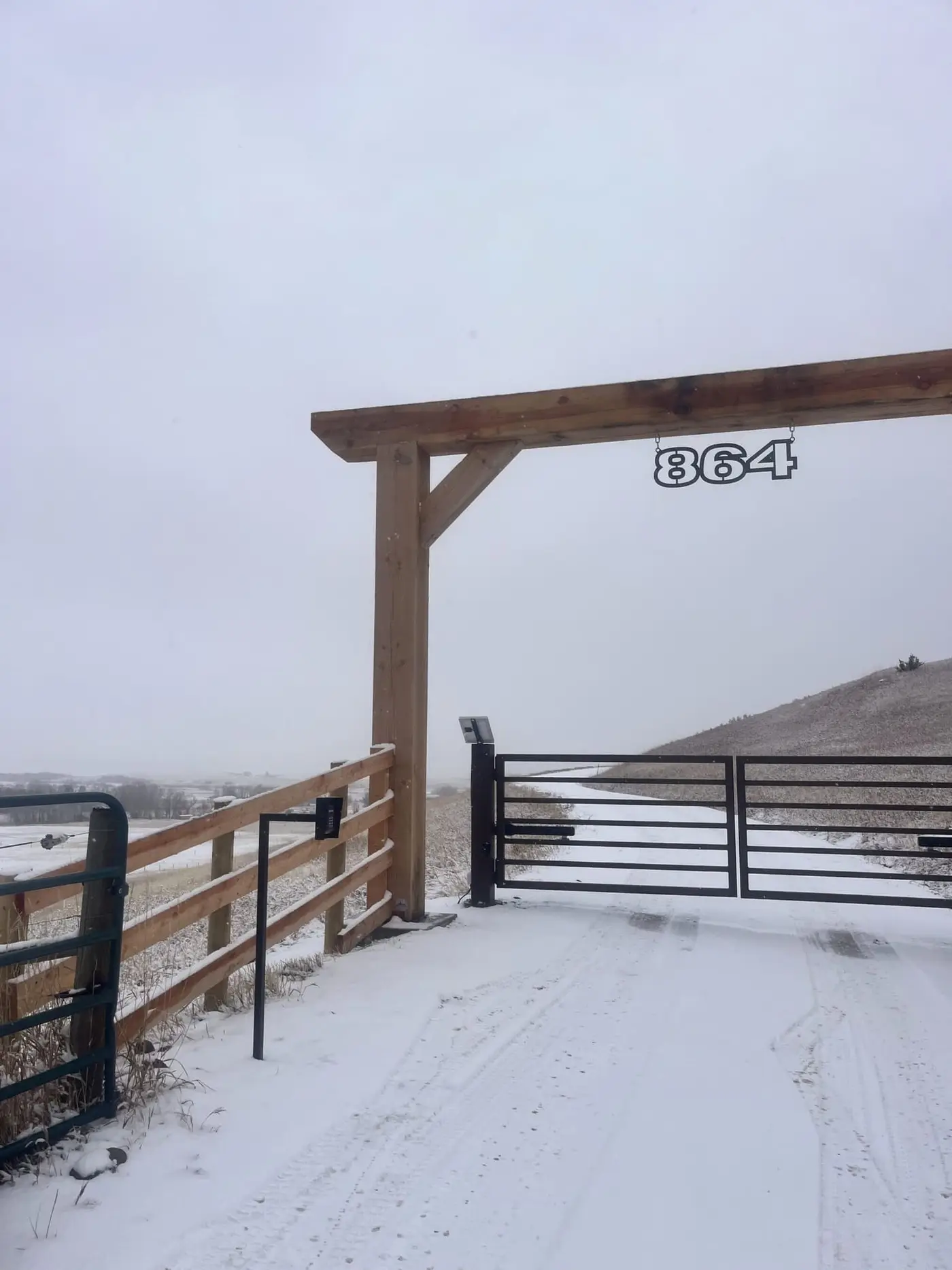
A practical rule: if you have flat, open room to the side and drifting is a real problem at your entrance, a slide gate has the advantage. If you have grade, rock, or no side room, swing is usually the honest choice — and then the arc has to become part of the winter plan, not an afterthought when the plow truck shows up. Either way, the hardware only performs as well as the posts and footings it hangs on. That’s the same discipline behind reliable automatic gates and entrance archways: a gate that moves an inch at the post fights itself all winter.
Why the gate belongs back from the road
Pulling the gate back from the county road is one of the cheapest upgrades in the whole entrance, and it does several jobs at once.
It creates stacking room. A truck and trailer can get fully off the roadway while the gate opens, which matters most on the roads where traffic moves fast and shoulders are narrow. It also gives a delivery driver somewhere to sit while they figure out the code instead of blocking a lane.
It keeps the gate out of the plow’s work. Snow thrown from the county road lands near the road. A gate set back is behind that pile, not buried in it.
It gives you room to straighten the approach. Setback plus a shaped flare turns a hard corner into a gentle one, and a gentle one is what lets a long rig track through without swinging wide into your fence.
It also makes room for a cattle guard if livestock are in the picture, which needs solid ground and a level approach on both sides to work the way it should.
Emergency access is a different set of dimensions
Fire and ambulance crews aren’t driving pickups. An engine or a water tender is wider, taller, longer, and heavier than anything you own, and it doesn’t back down a quarter mile of drifted driveway to get out. Before you finalize a gate, call your local rural fire district and ask them directly what they need to reach your buildings — width, overhead clearance, turnaround room, and how they want to get through a closed gate. Departments have preferences and they’ll tell you. It’s a five-minute call that can save a redesign.
Three things come up almost every time that conversation happens:
- A way through when the power is out. An automatic gate needs a manual release, a battery backup, or both, and somebody besides you has to know how it works.
- A turnaround they can actually use. A big truck needs a loop or a hammerhead on firm ground, not a soft shoulder and a three-point turn in the dark.
- An address they can find. Numbers visible from the road, from both directions, in winter, at night, without being screened by the archway.
Keypad and call box placement
The pedestal location gets decided by how people actually drive up to it.
Set it far enough back from the gate that a vehicle can reach it without the gate sweeping into the vehicle when it opens — and far enough back from the road that a truck with a trailer sitting at the keypad is entirely off the pavement. Height and offset matter more than people expect: a keypad set for a car window is a reach down from a semi cab, and one set for a truck is a stretch up from a sedan. Split the difference or set it for whatever comes most often.
Then plan the trench. Power and communication lines to a pedestal are utility trenching, and running conduit while the entrance is already torn up costs a fraction of doing it later. Set the pedestal footing with the same care as the gate posts — a keypad that heaves and tips over a few winters is fixable, but it’s a fix nobody enjoys.
What to look at on your own property
Take a walk to the entrance with this list:
- Scars. Rubbed paint on gate posts, chewed-up sod at the corners, broken fence stays near the opening. Those are your rigs telling you the opening is tight.
- The turn off the road. Stand in the driveway and watch the sight lines both directions. Then imagine a forty-foot combination making that turn from the far lane.
- Where snow ends up. In February, note the plow windrow, the drift line, and where roof or wind-driven snow collects. That’s the map of the arc you can’t use.
- Water and grade. A gate at the bottom of a dip collects water, then ice. Pooling at the pivot in October is a stuck gate in January.
- The turnaround. Can a truck that will not back up get itself pointed out again on firm ground?
- What’s fixed forever. Archway height, column spacing, and the gate opening are the parts that are hard to change later. Everything else is adjustable.
How wide should the gate be if I only drive a pickup?
Wide enough for the things that visit, not the thing you drive. Hay delivery, gravel, propane, fencing material, an equipment haul, and emergency apparatus all use the same opening you do. Size for that list, then confirm the approach lets a long rig actually track through it.
One gate leaf or two?
Two leaves cover a wide opening while keeping each leaf shorter, which means less sag, less wind load, and less strain on hinges and openers. One long leaf is simpler but asks a lot more of the hinge post. Wide openings usually end up as a pair for that reason.
Does an automatic gate change the width I need?
Not the width, but it does change the setback and the pedestal planning, and it puts more weight on getting the posts and footings right. It also introduces the power-outage question, which is worth settling before anything gets built rather than after.
Can I widen an entrance I already have?
Often, yes — sometimes by resetting posts or columns, sometimes by reshaping the approach so the existing opening is easier to hit. Which one makes sense depends on what’s built there now and how much room the frontage gives you.
Walking the entrance with a tape and a clear list of what has to come through settles most of this in one visit — request a free estimate and we’ll read the approach with you.