Most barn kits are designed for nowhere in particular. They come in the sizes a supplier stocks, built from lumber that was cut for somebody else’s project, and Montana isn’t on the box.
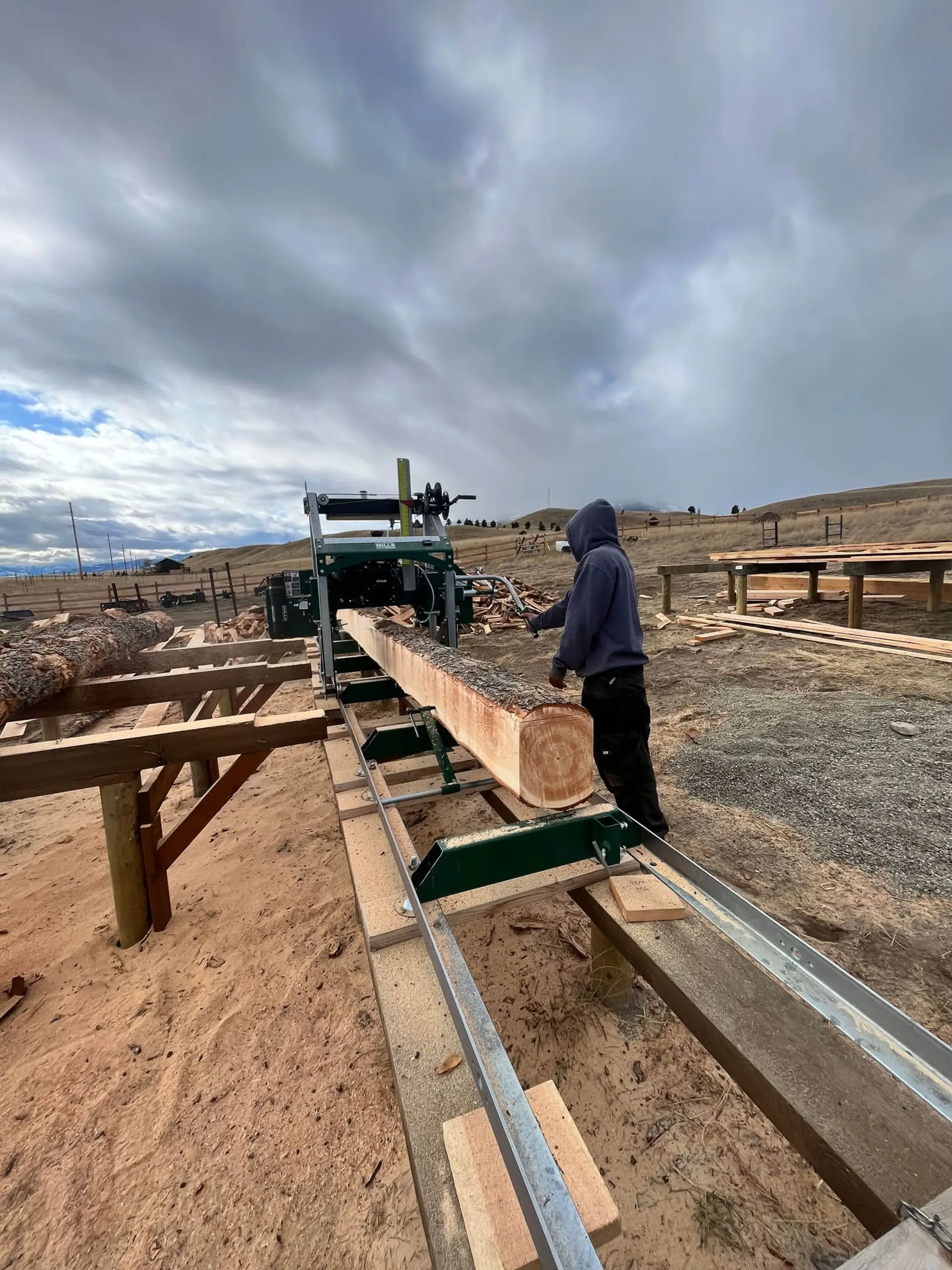
Ours start at our own sawmill. We mill the timber, cut it to a design worked out for your barn and your site, fit the connections, and mark every piece so the frame goes together in order. You get a post and beam package that’s ready to raise, not a pile of lumber and a problem.
What a Barn Kit Means Here
A kit is the hard part of a timber barn done properly: the posts, beams and bracing milled to size, cut to length, with the joinery and hardware worked out before anything leaves the mill.
What goes into a particular kit depends on the design and on how much of the work you want to do yourself. That’s why we scope each one per project instead of selling fixed packages. It’s the same approach we take with our pergola and arch kits, applied to a bigger building.
Who This Is Actually For
Builders and contractors who want the heavy timber done right without setting up to mill and cut it for one job.
Owners who genuinely do their own work and have the equipment and the help. Barn timbers are heavy, and raising a frame is a real undertaking. This is a practical consideration, not a formality.
Remote or hard-access sites where getting a crew out repeatedly is the expensive part of the project, and a delivered, pre-fitted package is a better use of everyone’s time.
If none of those describe you, having us build the barn is usually simpler. We build pole barns, horse barns, hay sheds and livestock shelters start to finish, and we’ll tell you honestly which path fits.
Why Milling It Ourselves Matters
Because the timber comes off our own mill, sizes are set by the design rather than by what’s in stock. Rough-sawn stock leaves the mill at full dimension with the saw texture still on it, so a post reads as a timber rather than as a piece of lumber. Our article on rough-sawn vs. surfaced lumber explains the difference.
We also see every piece from log to package, which is tighter quality control than buying whatever arrives on a truck. If you have timber on your own property, ask about it. Whether it suits a structural frame depends on the wood and the design, but it may be a good fit for siding or other parts of the project. Our piece on turning local timber into useful materials covers what that can look like.
The Design Has to Fit Montana
A barn frame isn’t decorative. It carries a roof, and in Southwest Montana that roof carries snow. Before anything is cut, the design has to account for:
- Snow load at your site. A barn in the mountains carries more than one on the valley floor.
- Wind on exposed ground, which is most open ground around Bozeman and Belgrade.
- Footings below frost depth, so the frame doesn’t heave. See our article on frost depth and footings.
- County requirements. Whether stamped engineering or a building permit is required depends on where you’re building and how the barn will be used. We sort that out before cutting, not after.
What a Kit Does Not Include
Worth being direct about this, the same way we are with our smaller kits.
Footings and site work. These depend on your soil and frost depth and are poured on site. We can do them, along with the excavation and pad, or your builder can.
The raising. Heavy timber needs lifting equipment and enough hands. We offer crane and structural services if you’d rather not improvise this step.
Everything beyond the timber frame. Roofing, siding, doors and anything else are worked out per project. Don’t assume a kit is a complete building unless we’ve scoped it that way together.
Finish. Timber can go up raw and weather to gray, or be finished. If you want it finished, doing it before assembly is far easier than after.
Delivery and Scheduling
Both depend on the project, and we’d rather give you a real answer than a general one.
Barn timber is heavy and long, so how a kit reaches you is a genuine logistics question: where the site is, what can get in, and how it comes off the truck. Cutting time depends on the design and on what else is running at the mill.
If You’re Not Sure
The most useful things to send are what the barn needs to hold, rough dimensions, a photo of the site, and whether you plan to raise it yourself. From there we can tell you whether a kit makes sense, what it would involve, and whether you’d be better off having us build it. We’d rather talk you out of a kit that’s wrong for your situation than sell you one you end up fighting.
Ready to talk through a barn kit? Start your estimate or call (406) 551-6772.