Both hold up here. Neither one is the “durable” choice and the other the “pretty” choice, which is how the comparison usually gets framed. The real difference is that a paver surface is a manufactured system built to move as a unit, and a flagstone surface is a collection of individual natural pieces that each have to be bedded on their own. That difference decides how each one is installed, how each one goes wrong, and what a repair looks like ten years in.
Here’s how the decision actually gets made on a Montana property.
The structural difference that drives everything else
Concrete pavers are made to consistent dimensions and consistent thickness. Set them on a properly compacted base with a thin screeded bedding layer, lock the edges, sweep sand into the joints, and the field behaves like a single flexible surface. Each unit is held by its neighbors. When the ground underneath moves a little — and in this climate it does — the surface can flex without cracking, because there’s nothing rigid spanning across it.
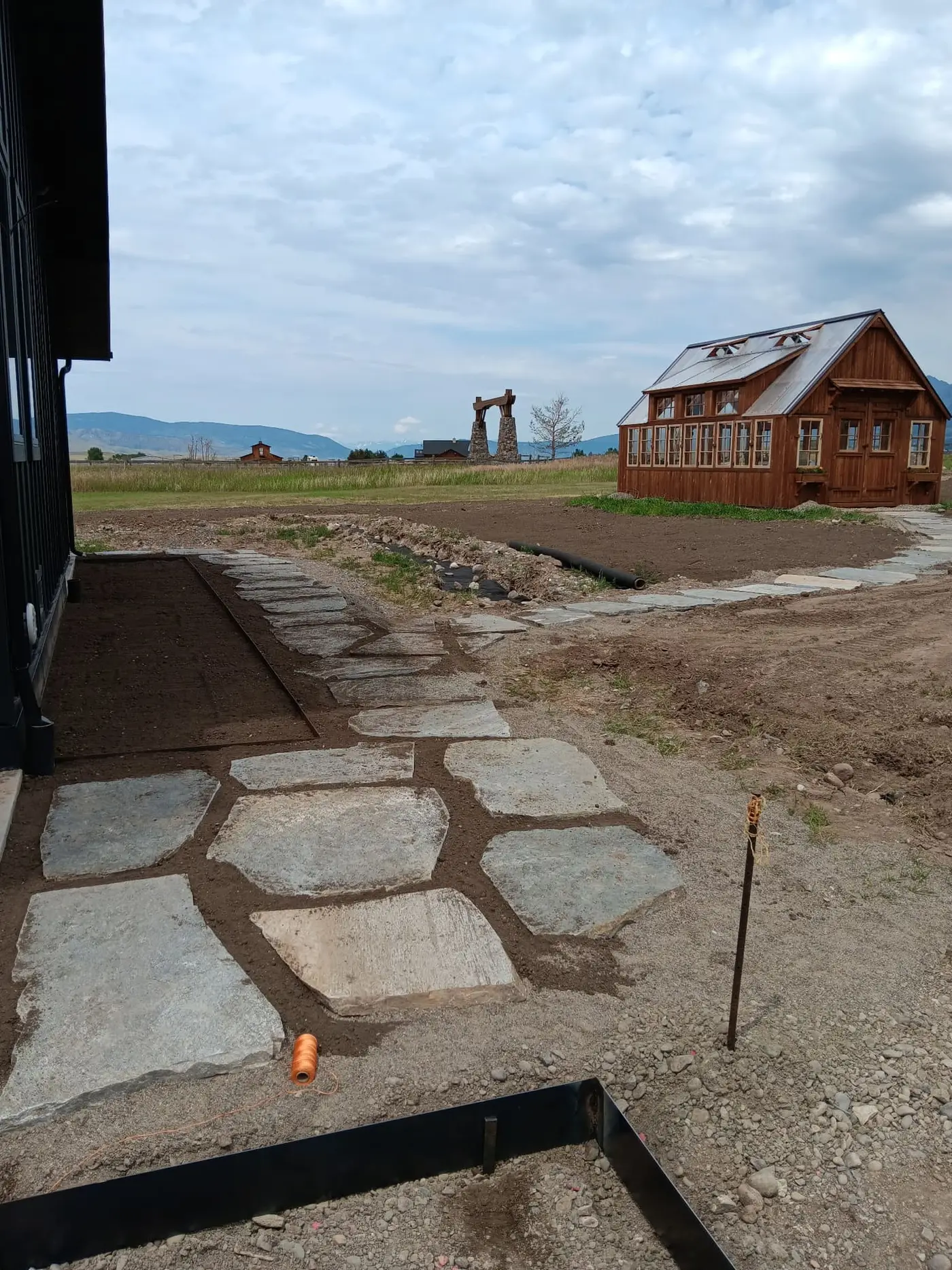
Flagstone is quarried, not manufactured. Thickness varies piece to piece, sometimes within a single piece. That means the installer is bedding each stone individually to bring the walking surface flat, which is slower, more skilled work than laying pavers to a screeded plane. It also means there are two very different ways to install it: dry-laid over a compacted base with sand or stone dust joints, or wet-set in mortar over a concrete slab.
That second choice matters enormously here. Mortared flagstone is a rigid assembly. Rigid assemblies and freeze-thaw are natural enemies, and the mortar joints are always the first thing to tell you so. If a mortared patio is going in, what’s under it has to be built like a real structure — a properly built slab on drained, compacted base, pitched to shed water — not a thin pad poured on native soil. Dry-laid flagstone sidesteps the problem the same way pavers do, by staying flexible.
Base preparation: same principles, different tolerances
Both surfaces need the same things underneath: organics dug out, drained aggregate compacted in lifts, real compaction all the way to the perimeter, and a pitch that carries water away from the house. That’s the part of the job nobody photographs and the part that decides how the patio looks in a decade. If you read nothing else about hard surfaces here, read what goes under a paver patio, because the base logic applies to stone just as much.
Where they differ is tolerance. Pavers are unforgiving of a base that isn’t flat, because the bedding layer is thin by design and can’t be used to correct grade. Flagstone’s varying thickness means the setting bed absorbs a little more variation by necessity — but that’s not permission to build a sloppy base. It just moves the skill from screeding to individual stone setting.
On sloped or awkward ground, the excavation and grading side of the project usually costs more than either material choice does, regardless of what goes on top.
Joints, weeds, and what fills the gaps
Paver joints are narrow and consistent. Swept sand — often polymeric — completes the interlock and resists washout. It’s maintenance you top up every few years, not a permanent fill.
Flagstone joints are wider and irregular, and you have real choices: stone dust or sand, polymeric sand, mortar, or planted joints with a low ground cover. Each has a personality. Wide sand joints look natural and drain freely, but they collect debris and grow weeds. Mortar joints look crisp and shed nothing, and in a freeze-thaw climate they are the component most likely to crack and need pointing. Planted joints look wonderful in July and are a lawn-maintenance project in perpetuity.
Wide joints also affect furniture. Chair legs, cane tips, and stroller wheels find gaps that a tight paver field doesn’t have.
Traction, snow, and ice
This is where Montana owners should think harder than they usually do.
Natural cleft flagstone has genuine grip when wet, because the surface is textured by how the stone splits. Sawn, honed, or polished stone can be slick, and a sealer that makes the color pop can make it slicker still. Pavers vary the same way: a tumbled or textured surface grips better than a smooth one.
Ice is the equalizer — nothing is safe under ice. What differs is snow removal. A shovel blade runs clean across a flat paver field and catches on irregular flagstone edges and raised lips. Steel plow and shovel edges chip stone and scuff paver surfaces. And deicing salt is hard on concrete products and mortar joints alike; a lot of owners here end up using sand on their walkways for exactly that reason.
If the surface is the path everyone takes from the driveway to the door in February, weight traction and shovelability heavily. If it’s the summer patio off the back door, weight looks and comfort.
How each one ages
Concrete pavers hold their shape well and can fade over years, since the color is pigment. New efflorescence — a white haze — is common early and generally weathers off. The bigger aging issue is matching: if you need replacements later, a new batch may not match a sun-weathered field, which is why keeping a small stack of leftovers in the shed is genuinely worth doing.
Natural stone doesn’t fade, it patinas. Lichen, moss on the shaded north side, and a softening of the cut edges are all part of the appeal. The variable is the stone itself: dense, low-absorption stone like quartzite handles freeze-thaw far better than a soft, porous stone that drinks water and can flake or delaminate. Ask what stone it is and where it came from, not just what color it is.
Repairs: the honest comparison
| Concrete pavers | Flagstone (dry-laid) | Flagstone (mortared) | |
|---|---|---|---|
| Fixing a settled spot | Lift units, rebuild base, reset — often invisible | Lift stones, rebed, reset — invisible if the same stone goes back | Requires breaking out mortar and often the slab |
| Matching later | Color batches drift; keep spares | Natural variation helps hide a new piece | Patched mortar rarely blends |
| Most common failure | Edge creep where restraint was skipped or base was soft at the perimeter | Individual stones rocking underfoot | Cracked joints, then water in the crack, then more cracked joints |
| Cutting and curves | Cuts cleanly to layout | Fitted by hand, slower | Fitted by hand, slower |
The short version: both dry-laid systems are repairable in place by someone with a pry bar and patience. Mortared work is masonry, and repairs are a masonry job.
What to look at on your own property
Before you decide on material, walk the spot and answer these:
- Where does water go now? Stand there after a rain or during snowmelt. Low spots, sheet flow off the lawn, and the roof dripline all matter more than material.
- Where does snow get pushed and piled? A patio in the plow path or under a sliding metal roof gets treated differently than a sheltered one.
- Which side gets sun? North-side and shaded surfaces stay icy and grow moss. That’s a traction argument.
- What’s in the ground? Dig a test hole. Topsoil depth, clay, cobble, and how wet it is at depth drive the excavation, which drives the budget.
- Are there steps involved? Grade changes push the conversation toward stone or paver staircases, and the stair material usually wants to relate to the patio material.
- Barefoot or boots? Comfort underfoot in August is a legitimate criterion, and irregular flagstone reads differently to bare feet than a flat paver field.
Can I use both on one property?
Yes, and it often looks better than picking one. A common pattern is a paver field for the main patio with flagstone at the landings, steps, or a feature area — or flagstone stepping stones for a garden path with pavers on the working walkway. The trick is making the transition happen at a logical break, like a step or an edge, so it reads as deliberate.
Is mortared flagstone a bad idea in Montana?
Not bad — just demanding. It requires a well-built, well-drained slab underneath and an owner who accepts that joints will need pointing over time. Dry-laid flagstone is the lower-risk answer on most residential sites here.
Should I seal it?
Sealers can deepen color and help resist staining, but they can reduce traction and they’re recurring maintenance. On a walkway you’ll use in winter, think hard before sealing. On a covered outdoor kitchen area, it makes more sense.
Which one costs more?
Neither is automatically cheaper. Cost is driven by excavation depth and soil, machine access, square footage, layout complexity, stone thickness and sourcing, the amount of cutting and fitting, and any steps or walls the grade requires. Two projects with the same material can land far apart because of what’s under them.
If you want a straight read on which fits your ground, set up a free estimate and we’ll look at the soil, the water, and the winter path before anyone talks about color.