Rough-sawn is lumber as it comes off the saw: full dimension, saw-textured, usually still carrying moisture. Surfaced lumber has been run through a planer to smooth the faces, which makes it clean and consistent and also makes it smaller than the number stamped on it. Ask for rough-sawn where the timber is the look and the size needs to be honest, and surfaced where things have to fit tight, sit flat, or get touched by hands.
That’s the short answer. The reason it matters is that “6x6” means two different pieces of wood depending on which shop you’re standing in, and finding that out mid-build is an expensive way to learn it.
What the two terms actually mean
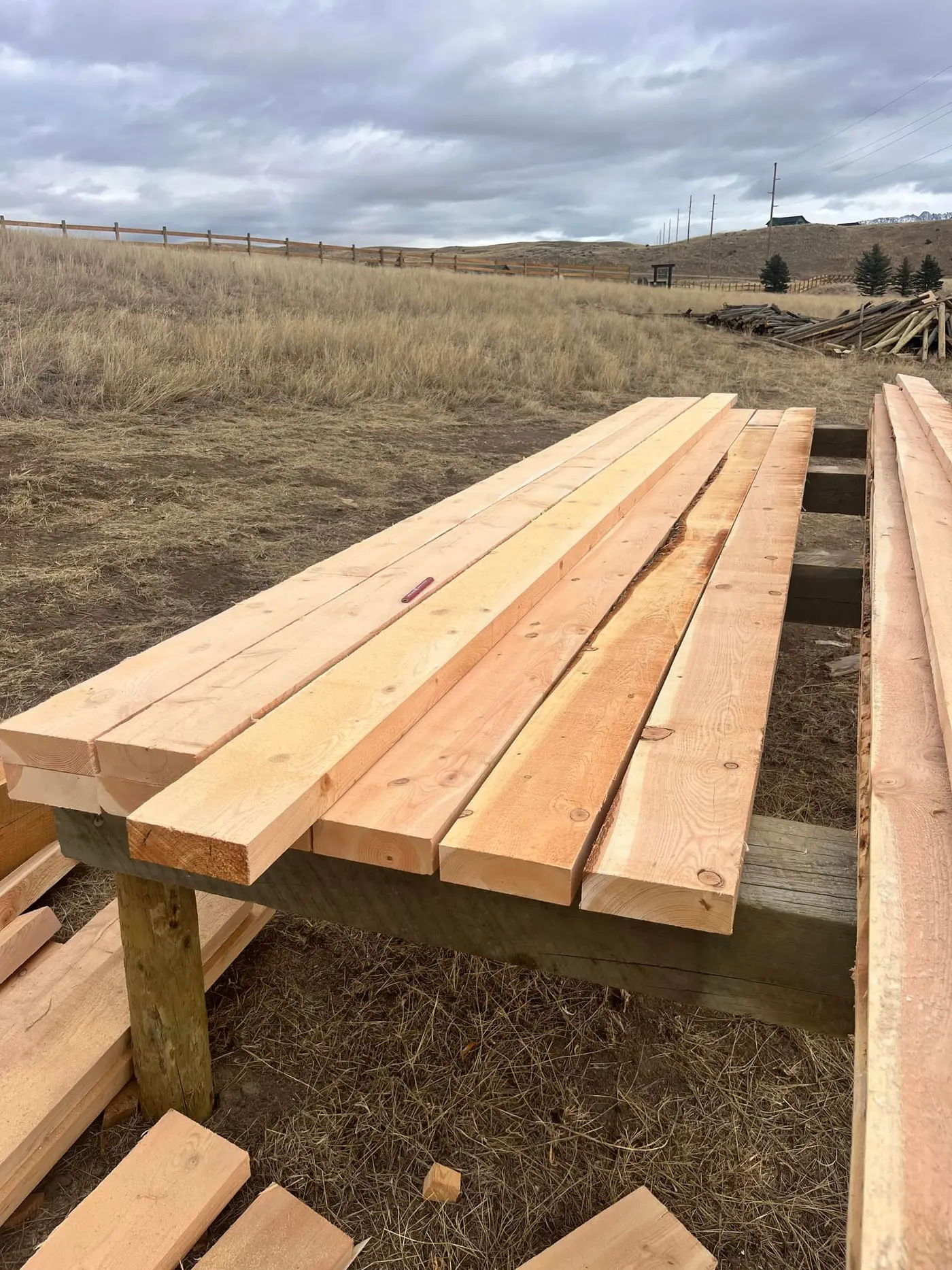
Rough-sawn is the mill’s output before any further milling. The band or circular saw leaves a texture on all four faces, and the piece is cut to the dimension you asked for. A rough-sawn 6x6 off a mill measures close to a true six by six. It’s slightly fuzzy, slightly variable face to face, and it looks like wood that was cut rather than manufactured.
Surfaced lumber, often written S4S (surfaced four sides), has been planed after sawing. Planing takes material off every face to produce a smooth, uniform, square stick. This is what the lumberyard sells for framing, and it’s what most people picture when they say “lumber.”
There’s a middle option worth knowing: skip-planed or hit-and-miss material, where the planer takes just enough to knock down the fuzz and even out the thickness while leaving saw marks in the low spots. It reads rough but handles closer to surfaced. On visible timber work it’s frequently the sweet spot.
Why a rough-sawn 6x6 is not a surfaced 6x6
The dimensional gap is the single most useful thing to understand here, and it trips up homeowners and contractors alike.
Everybody already knows the nominal-versus-actual convention from a 2x4, which is not two inches by four inches. Surfacing is where that difference comes from: the planer removes material from each face, so a nominal 6x6 in surfaced softwood measures noticeably less than six inches square. Rough-sawn from a custom mill doesn’t go through that step, so the timber stays at or very near the full called dimension.
Practically, that means:
- A rough-sawn timber is physically bigger than a surfaced one of the same name. It reads heavier from thirty feet away, which is the entire point on an archway or a pergola beam.
- Hardware sized for surfaced lumber may not fit rough-sawn. Post bases, brackets, joist hangers, and connectors are built to the standard actual dimensions. Order those to the timber you’re actually using, not the number you call it.
- Mixing the two in one assembly creates offsets. If half the frame is full-dimension and half is planed, faces won’t align and you’ll be shimming.
- Repairs decades from now depend on the dimension still existing. This is one of the real arguments for milling: an old barn built from full-dimension stock can be patched with matching stock from a custom sawmill, while the yard has nothing that fits.
| Question | Rough-sawn | Surfaced |
|---|---|---|
| Actual size vs. name | Full or near-full dimension | Smaller than nominal, consistently |
| Surface | Saw texture, some fuzz | Smooth, uniform |
| Visual weight | Heavier, more presence | Trimmer, more refined |
| Tight-tolerance joinery | Requires more fitting | Easier, predictable |
| Stain and finish behavior | Soaks in, more coating needed | Even, less coating |
| Contact with hands and bare feet | Poor without sanding | Good |
| Typical availability | Milled to order | Off the shelf |
Where rough-sawn belongs
Rough-sawn earns its place anywhere the timber is doing visible structural work and you want it to look like timber.
Timber frames, exposed rafters, and heavy posts are the obvious cases. A timber pergola built from full-dimension rough stock has proportions that planed material can’t fake, because the beams genuinely are bigger. The same logic drives entrance work: the uprights and header on a log or timber archway are meant to read as substantial from the county road, and shaving a half inch off every face works directly against that.
It also belongs on rustic siding and trim, corral and shelter framing, board-and-batten on outbuildings, and anywhere the material will weather in the open. Saw texture holds stain and oil better than a planed face does, which is a genuine advantage on exterior work that will get recoated over the years.
Where surfaced is worth paying for
Surfaced material wins wherever tolerance, contact, or cleanliness matters.
Anything people touch regularly should be smooth: deck surfaces, railings and handrails, bench tops, bar tops in an outdoor kitchen. Rough-sawn decking is a splinter delivery system, and no amount of character makes up for that on bare feet.
Surfaced also wins where pieces have to fit: cabinetry, trim against drywall or stone, doors, anything with joinery tight enough that a sixteenth matters. And it wins on conventional framing inside a pole barn or shop, where the material is going to be covered anyway and consistency speeds the build.
The common answer on a real project is both. Rough-sawn for the timbers you see, surfaced for the surfaces you touch, and skip-planed where you want texture without splinters.
Drying and movement: the part that decides how it behaves
Size and texture are what people ask about. Moisture is what actually determines whether they’re happy in two years.
Fresh-cut lumber is heavy with water. As it dries it shrinks, and it shrinks very unevenly: a lot across the width and thickness, almost nothing along the length. That single fact explains most of what goes wrong. Boards cup and twist, timbers check along their faces as the outside dries faster than the core, and joints that were tight when built open up over the first summer.
None of that is a defect in a heavy timber. Checking on a big post is normal and generally cosmetic. What matters is designing for it:
- Green timber works fine for rough outdoor structures, corrals, and rail stock where movement doesn’t break anything. Build it knowing it will shrink.
- Air-dried takes months and depends on thickness, stacking, and season. Timbers dry slowly, and thick material never fully dries in the middle.
- Kiln-dried is the answer where dimensional stability is the requirement, and it’s why surfaced yard lumber behaves the way it does.
The hard truth on big timbers: a genuinely dry 8x8 is rare and expensive, so most timber-frame work is built with material that will move, using connections and detailing that tolerate it. Sequence matters too. If you’re staining, let the wood reach a stable moisture level first, or the finish goes on wet wood and fails early.
What to look at before you order
Walk the project and answer these:
- Will anyone touch it? Hands and feet mean surfaced or heavily sanded, without exception.
- Is it visible structure or hidden structure? Visible is a rough-sawn conversation; hidden is a cost-and-speed conversation.
- What hardware is it landing on? Confirm the connector fits the actual dimension before anything is cut.
- How dry is it and how dry does it need to be? Ask the supplier directly. “Green,” “air-dried,” and “kiln-dried” are three different products.
- Does the size need to match something existing? Old structures usually mean full dimension, which usually means milling.
- How is it stored between delivery and install? Stacked flat, stickered, off the ground, out of direct sun. Material left in a pile on wet ground will move before it’s ever fastened.
Is rough-sawn lumber stronger than surfaced?
At the same call-out, a full-dimension rough timber simply has more wood in it than a planed one, which is not nothing. But structural sizing is an engineering question for your specific span and load, not a reason to assume rough-sawn covers you. Size the member for the job, then decide how it’s finished.
Can rough-sawn be used indoors?
Yes, and it’s a common look on ceilings, mantels, and accent beams. Expect to sand contact areas, and expect more finish product to be absorbed than a smooth board would take.
Does rough-sawn cost less because it skips a step?
Not reliably. It skips planing but usually means milling to order, and it contains more actual wood per piece. Cost is driven by species, dimension, length, drying requirements, and quantity far more than by surface.
Can I get rough-sawn in the exact sizes I want?
That’s the main advantage. A mill cuts to the list, which is how odd thicknesses, extra-long rails, and matching stock for an old building get made. Our own timber and milling work exists largely for that reason.
Bring your cut list, or just the project, and start a free estimate — we’ll sort out which pieces should be rough and which should be smooth before anything gets cut.