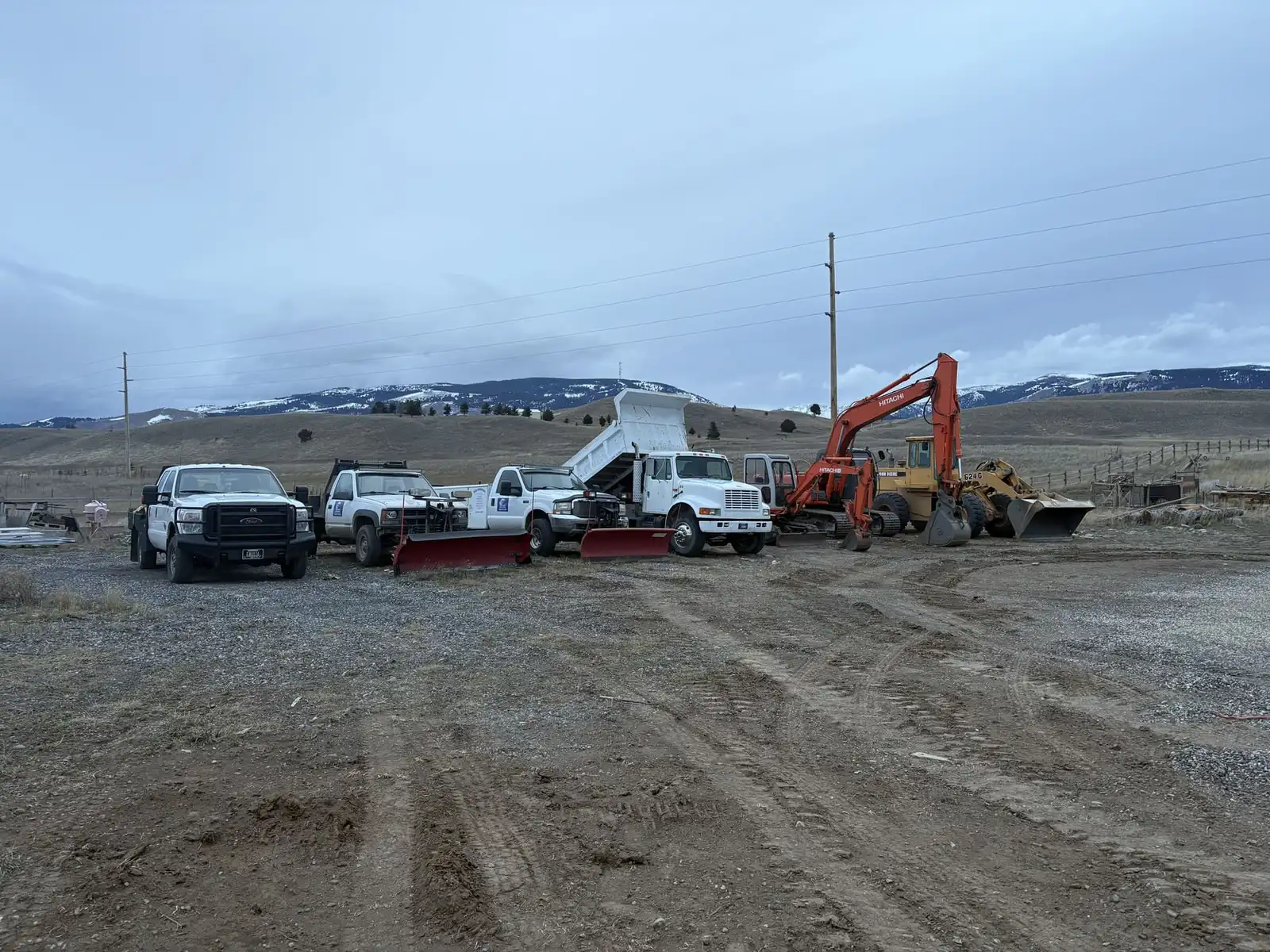
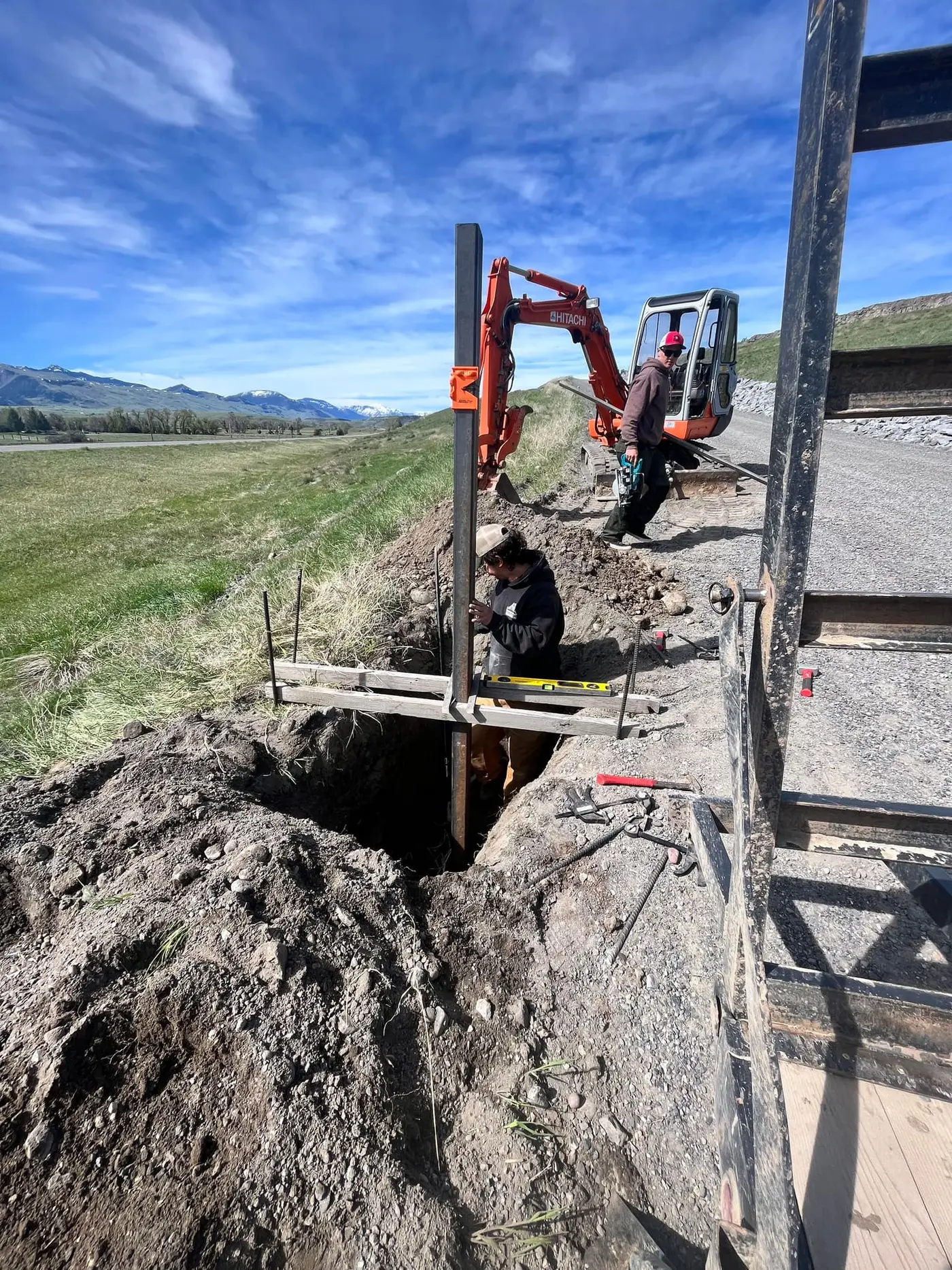
The digging is the easy part. A utility trench on rural ground is mostly decided before the machine moves: knowing what’s already buried out there, deciding what shares the ditch, and picking a route the ground will actually allow. Get those three right and the trench is a short chapter in the project. Get them wrong and you dig the same line twice, or you live with a settled scar across the pasture for the next ten years.
Here’s how the decisions actually get made on a rural parcel, where the runs are long, the records are thin, and nobody’s line is on a plat.
Locating what’s already down there
Start with a locate request through the one-call service. It’s free, it’s the first phone call of any dig, and it brings out the utility-owned lines: the electric service, gas if you have it, telecom, anything a company owns and maintains up to a meter or pedestal.
That’s the easy half. On a ranch, the dangerous half is everything past the meter, because private lines are nobody’s job to mark but yours. The buried feed from the meter pole to the shop. The old irrigation main somebody trenched in during a different decade. The water line to the stock tank. Septic tank and drainfield laterals. The abandoned line that may or may not still be hot.
Nobody has a map of those, so the map gets built from what you can assemble:
- Old photos of the property, especially any taken while a trench was open
- Well logs and septic permits, which frequently show line routes even when nothing else does
- The previous owner’s memory, which is worth a phone call even years after closing
- The obvious surface clues — a pedestal, a riser, a hydrant, a valve box, a strip of grass that greens up differently, a slight swale that never quite settled
- Private locating when the guesses conflict and the consequences are serious
Two lines matter more than the rest for reasons beyond cost: a buried electrical conductor is a life-safety hazard, and a septic system is expensive and unpleasant to rebuild. When we plan utility excavation, those two get located to a confidence level well past “I think it runs about there,” and the trench route bends around them rather than gambling.
One trench or several: decide before you price it
The temptation on a long rural run is obvious. If the shop needs power, water, and a data line, why open the ground three times? Often you shouldn’t, but a shared trench is a coordination problem, not a shortcut, and it wants planning.
The complications are real. Each utility has its own required burial depth, and they aren’t the same depth, so a shared trench is dug to the deepest requirement and the shallower lines get placed as the backfill comes up. Each has its own bedding and backfill spec. Each may need its own inspection at its own moment, which means the trench stays open until several different people have looked in it. And some providers simply won’t share a ditch with a foreign line, or will only share on their terms. Ask them before you dig, not after you’ve got an open trench and a scheduling problem.
| Situation | Usually points toward |
|---|---|
| Long run to a new shop or barn, all utilities known now | One planned shared trench |
| Provider requires a dedicated ditch for their conductor | Separate trench for that line |
| Utilities needed at different times, years apart | Shared trench now with spare conduit |
| Route crosses rock or a wet section | Fewer trenches, one careful route |
| Short run in easy ground, one utility | Just dig the one |
The pattern that saves the most money over time isn’t the shared trench itself; it’s spare capacity. Empty conduit costs a fraction of what a second trench costs, and it’s placed while the ditch is already open. If there’s any chance of a future pole barn, an arena, a well pump, an outdoor kitchen, or a data line to a corner of the property, put the sleeve in now with a pull string in it and mark both ends.
Separation, sleeving, and marking
Separation between lines in a shared trench is not a preference. Horizontal and vertical spacing between power, water, gas, and communications comes from each utility’s spec and from whatever the inspector works out of. A trench that gets crowded because everything was thrown in at one level is a trench that fails inspection and gets reopened, which is the most expensive way to save an hour.
Sleeving is the other decision worth making while the ground is open. Anywhere a line passes under something you’d hate to cut later — a driveway or ranch road, a concrete slab or apron, a future building pad — the line belongs in a sleeve sized larger than the line, run past the edges of the crossing on both sides. Sleeves let you pull a failed line out and pull a new one in without touching the surface above it. Skipping the sleeve under a driveway is a decision you make in ten minutes and regret with a saw.
And mark the trench while you can see it. Warning tape above the line in the backfill, tracer wire on anything non-metallic so a locator can find it later, photographs with a tape and a fixed reference (a corner, a building line, a fence post), and measurements written down somewhere that isn’t a phone. The person who finds your line in twenty years may be you.
Rock and frost: the route is a ground decision
Two things pull the route around more than anything on a plan.
Rock. Glacial cobble, shallow ledge, and river rock are ordinary here, and they change trenching from a production job to a slow one. Rock can also change the trench itself — a rock-heavy dig may need imported bedding material around the line, because backfilling a pipe or conductor with the sharp broken material you just pulled out of the hole is how a line gets damaged during the backfill instead of during service. A test hole or two along a questionable route is cheap next to redesigning mid-dig.
Frost. A water line has to sit below frost depth for your particular site, and depth is site-specific: elevation, aspect, soil, snow cover, and exposure all move it. The same principle governs footings and foundations, and it’s the reason a waterline is usually what sets the depth of a shared trench. Freeze-thaw also works on the backfill above the line, which is one more argument for compaction done properly rather than a ditch pushed full and driven over once.
Backfill and restoration: the part that shows up for years
Anyone can open a trench. The difference between crews shows up a year or two later, in whether there’s a line of settled ground running across your property.
A trench backfilled in one push is loose material sitting in a slot, and it will consolidate on its own schedule — usually over the first few wet cycles, unevenly, leaving a depression that collects water, catches a mower, and gets progressively more obvious. Backfilled in lifts and compacted as it comes up, the same trench stays where you put it.
Three restoration details worth asking about specifically:
- Where the trench crosses a road or drive, backfill and compaction requirements are stricter than they are across pasture, because a settled trench under gravel becomes a pothole that reforms every time you fill it. Utilities cross under a future road before the surfacing goes down, not after.
- The trench should not become a drain. A trench full of loose, permeable backfill running downhill toward a building is a French drain nobody designed. Route matters, and so does not aiming a fresh trench line at your foundation.
- Topsoil goes back on top. Stripped separately at the start, respread at the end, then seeded. Trench spoil turned upside down grows weeds for years; topsoil respread over compacted backfill grows grass and hides the line.
Slight crowning over the trench is normal and intentional; it accounts for the last bit of consolidation. What isn’t normal is a trench line you can still find with your eyes three years later.
What to look at on your own property
Before you call anybody, walk the route with a notebook:
- Where does the line start and end? Meter, panel, well head, tank, building — mark both ends physically.
- What’s already in the way? Pedestals, risers, valve boxes, the septic tank lid, old fence lines, the greener stripe in the grass.
- What does the route cross? Driveway, road, ditch, creek, future building pad, existing lawn or patio — each crossing is a sleeve decision.
- What’s the ground like? Rock at the surface anywhere along it? A section that’s wet in May and dry in September? A steep pitch?
- What might you want later? Every future power, water, or data need on that side of the property is a spare conduit decision made once.
- Can equipment get there? A trencher or excavator has to reach the whole line, and so does the material.
Do I really need a locate for a short trench?
Yes. The hazard doesn’t scale with the length of your dig. A hand-dug hole finds a buried conductor as effectively as an excavator does, and the locate request costs nothing.
Can I put power and water in the same ditch?
Often, with planning: the trench goes to the deepest requirement and the lines get placed with the separation each provider requires. But confirm with your electric provider first, because some won’t share a trench, and that answer changes the whole plan and price.
What’s the best season to trench in Montana?
Generally after spring saturation drains and before freeze-up. Frozen ground slows the digging, and saturated ground makes proper compaction of the backfill nearly impossible, which is the half of the job that determines whether the trench line disappears or lingers.
Should I put in conduit I don’t need yet?
If there’s any realistic future use on that run, yes. Empty sleeve placed in an open trench is the cheapest utility work you’ll ever buy, and it’s the only version that doesn’t involve digging.
If you’re planning a run to a shop, barn, well, or new building site, request a free estimate and we’ll walk the route, read the ground, and plan the trench around what’s already down there.