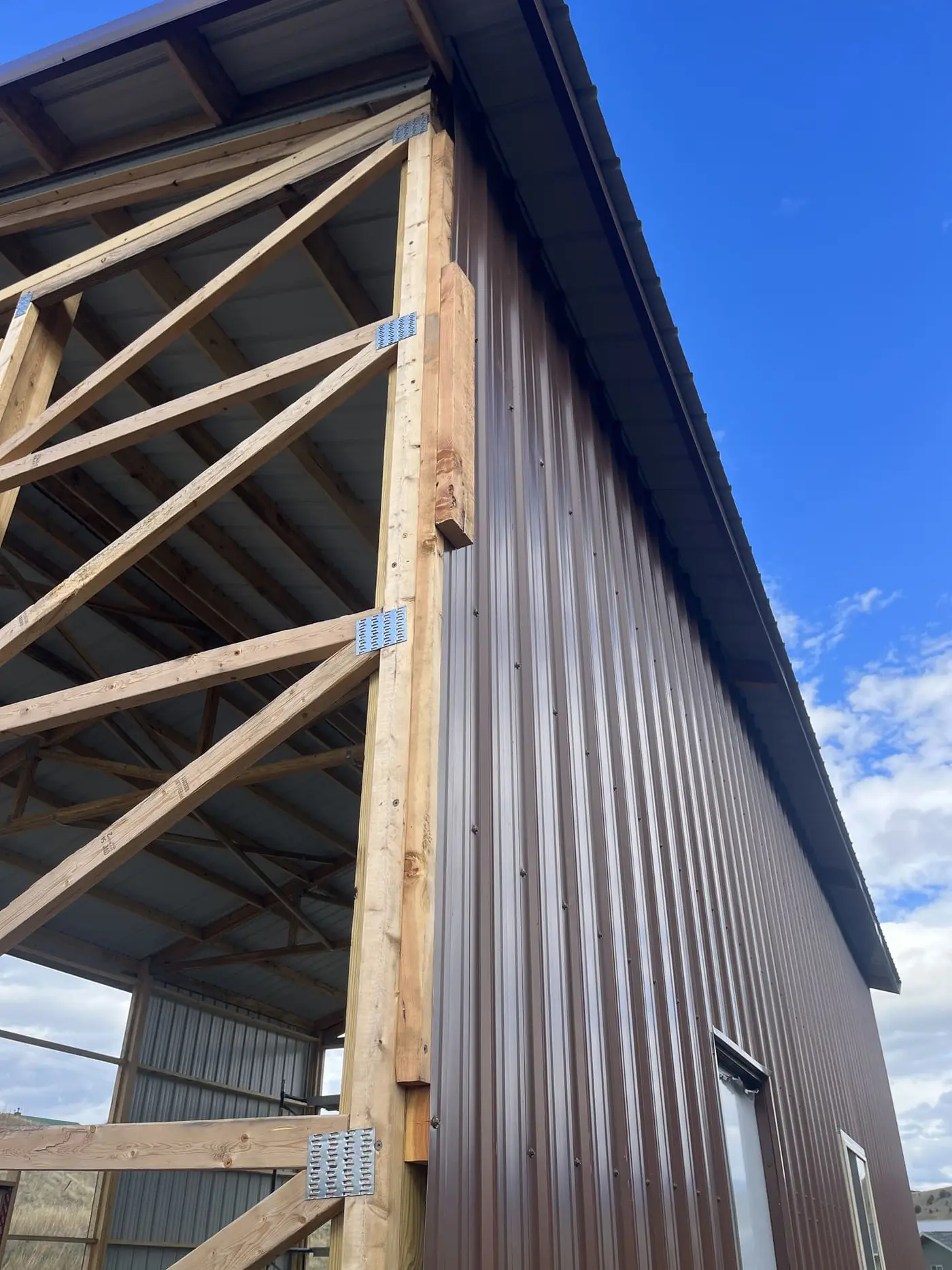
A hay shed has two jobs that pull against each other: keep water off the stack, and let air keep moving through it. The roof is the easy half. The half that decides whether your bottom row is still feed in March is airflow — through the building, through the stack, and up out of the ground underneath it.
That’s why a hay shed is built open and a pole barn is built closed. They are not the same structure with a different budget. Close in a hay shed to keep the weather out and you’ve built a lid over a pile of feed that’s still trying to breathe.
Moisture is the only enemy that really costs you
Rodents chew, sun bleaches the outside of a stack, wind scatters loose leaf. Those are annoyances. Water is the one that turns hay into bedding.
Hay that stays damp molds. Hay stacked with too much moisture in it heats, and heating hay loses feed value on its way to becoming, in the worst cases, a fire you didn’t plan for. None of that requires a leak in the roof. It happens under sound tin, on dry days, because moisture got in and had nowhere to go.
It arrives from three directions, and a good shed answers all three:
- What came in with the bale. Hay put up a little tough still has drying to do in the stack. A shed that moves air lets it finish. A sealed one keeps it wet.
- What comes up from the ground. Soil moves water upward year-round. Set a bale directly on dirt and it wicks, quietly, from the bottom.
- What condenses under the roof. A cold clear night on bare metal over a warm stack makes a roof sweat, and that water drips straight back down onto the top course.
Air needs a way in low and a way out high
Ventilation isn’t one opening — it’s a path. Warm, damp air off the stack rises. If it can’t leave at the top, it cools against the underside of the roof and comes back as drips.
The practical version: air enters low along open sides and eaves, moves through the stack, and exits high at a ridge vent or open gable ends. Take away either end of that path and the whole thing stalls. A shed with big open sides and a tight, unvented peak still traps a warm damp layer right where the top bales live.
This is also the reason a spare corner of an enclosed barn is a poor long-term hay spot. It can work for a small amount of hay you’ll feed out quickly. For a season’s worth, an enclosed building with doors shut against the weather is the exact condition you’re trying to avoid, and adding a lean-to on an existing structure is often the cleaner fix — open face, own roof, no new footprint fight.
Which side you leave open, and why the wind decides
Every hay shed is a compromise between “let the wind through” and “keep the snow out.” You resolve it by reading your own ground, not by rule of thumb.
Open faces pointed into driving weather load the stack with blowing snow and rain, and blowing snow gets into the stack, not just onto it. Faces turned away from the prevailing storm direction stay drier but move less air, so the side and ridge venting has to carry more of the work.
Snow drift is the part people forget. Any solid wall creates a drift on its downwind side, and a shed sited without thinking about that ends up with a drift piled exactly where you need to drive in February. Watch where the drifts already form on your place — along fence lines, behind the windbreak, on the lee side of existing buildings. Those drifts have been telling you the prevailing direction for years.
Sun exposure matters for a reason that has nothing to do with the hay: an open face that catches winter sun keeps the apron in front thawed and workable, and that’s where you’ll be running a loader in the dark.
What the stack sits on
The bottom row carries the whole stack and takes the worst of the ground moisture, which makes it the most expensive row to lose. The surface under it is a real decision, not a detail.
| Stacking surface | What it does well | Where it costs you |
|---|---|---|
| Bare dirt | Nothing to build | Wicks moisture up into the bottom course; goes to mud at the edges; ruts under a loaded loader |
| Compacted, crowned gravel pad | Drains, stays firm under equipment, sheds water away from the stack | Needs real site prep and grading to work — a flat pad just holds water |
| Gravel pad plus pallets or dunnage poles | Breaks ground contact and lets air under the bottom row | Adds material and handling; dunnage needs to be sound, not scrap |
| Concrete slab | Cleanest surface, easiest to scrape, best for shared-use buildings | Highest cost; flatwork is worth it when the building does more than hold hay |
Rough-cut dunnage is one of the places local material earns its keep — slabs and poles off a sawmill do this job well and don’t have to be pretty.
Whatever the surface, the pad should sit above the ground around it, shed water outward, and extend past the drip line of the roof. Roof runoff landing at the edge of a stack undoes everything else you did right.
Stacking so the air can actually get through
A tight, perfectly packed stack is a solid block. Solid blocks don’t breathe.
- Leave channels. Gaps between rows, running the direction air is moving, give the middle of the stack a path out.
- Keep the stack off the walls. Bales pressed against sheeting sweat against it and stay wet on that face.
- Leave headroom. Don’t stack to the underside of the roof. Air needs to move across the top course, and condensation needs somewhere to go besides straight into it.
- Don’t nest bales tight where they touch. Any spot where two bales trap a shaded, still pocket is where mold starts.
- Stack for stability first. Height is limited by what stacks safely and what your loader can place and pull without dropping a row on itself.
Leaving yourself room to work
Sheds get sized to the hay and then turn out to be miserable to use. Two clearances decide that:
Overhead. The opening has to clear your tallest loaded implement with the forks or grapple up, not just the machine sitting empty. That’s a build-time decision — you can’t raise a header later.
In front. A loader needs turning and backing room on the apron, on a surface that stays firm when it’s wet and can be plowed when it’s not. If the only approach is a tight corner between the shed and a fence, you’ll be doing three-point turns with a load in the air all winter.
Think about feed-out order too. Hay stacked first is fed last, and if the shed only opens on one end, you’ll be pulling from the newest hay first whether you meant to or not.
What to look at on your own property
Walk the site before anyone talks about trusses:
- Where do drifts already form in a normal winter? That’s your wind, answered.
- Does water run across the proposed pad in spring melt, or around it?
- Is the ground there higher than what’s around it, or is it the low spot everything drains toward?
- Which direction will the loader approach from, and does it have room to turn with a load up?
- How much winter sun hits the working face?
- Where does roof runoff land, and where will it go once it’s a sheet of ice?
- If you’re storing in an existing building now, pull a bale out of the middle of the bottom row and look at the underside. It’ll tell you what your current surface is doing.
Can I close in a hay shed if snow keeps blowing into the stack?
Partially, yes — a back wall and end walls are common and help a lot. What you shouldn’t do is close it up tight. Keep an open face and keep the high venting, then handle the snow with orientation and a wall on the weather side rather than by sealing the building.
Is hay ruined if it molds only on the outside of the stack?
Edge spoilage is normal and it’s why experienced operators feed the outside rows first. The rows against the drip line, the windward face, and the bottom course take the moisture, and treating them as the sacrifice rows keeps the loss where you planned it instead of in the middle of the stack.
Can I store hay in the pole barn I already have?
Short-term, sure. For a season’s supply, an enclosed building without real ventilation works against you, and hay in a shop or equipment barn also puts a fire load next to fuel and machinery. A separate open-sided structure, or a lean-to off what you have, is usually the better answer.
Does a hay shed need a concrete floor?
Not for hay alone — a properly built and drained gravel pad does the job. Concrete makes sense when the building will also see equipment, feeding, or eventual conversion to something else. Decide that before the posts go in, because floor prep is cheap during construction and expensive after.
If you’re planning storage for next season, start a free estimate and we’ll walk the site, read the drifts and the drainage with you, and size the structure to the hay and the equipment that has to get to it.