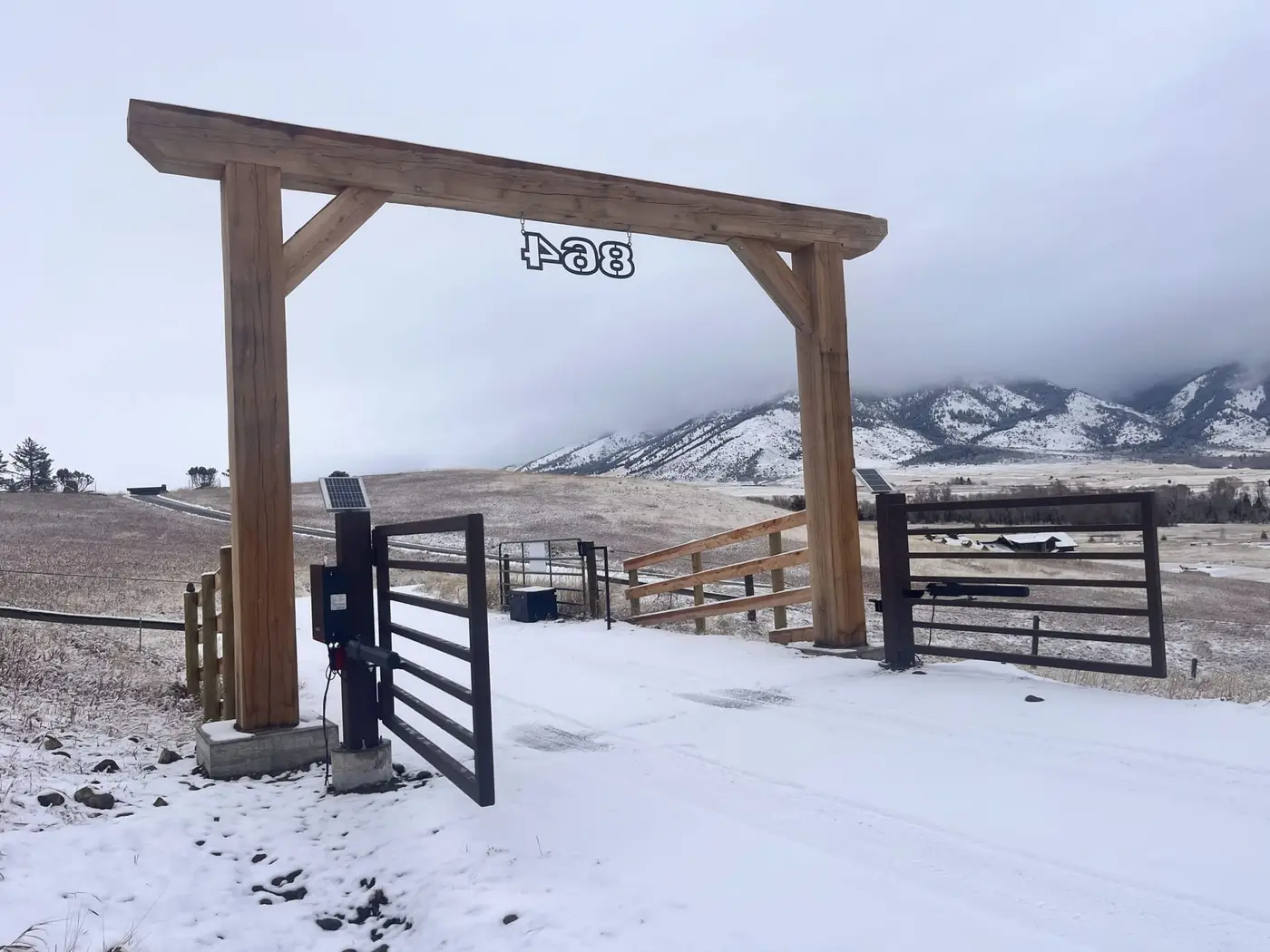
Both swing gates and slide gates work in Montana. They fail in different ways, and your driveway usually tells you which one to build. Snow, slope, space, and wind sort out most of the decision before anyone talks about looks or hardware.
Here’s how we think through it on a site visit.
The short answer
- Flat ground, room to swing, moderate snow: a swing gate is simple, classic, and hard to beat.
- Drifting snow, tight space in front of the gate, or a slope across the arc: look hard at a slide gate.
- Heavy snow and room alongside the opening: a cantilever slide gate, which keeps nothing on the ground across the driveway, is often the most reliable choice.
Snow and drifting
Snow is the biggest factor in Montana, and it’s where the two gate types differ most.
A swing gate sweeps through a quarter circle every time it opens. Everything in that arc has to stay clear all winter: plow berms, drifts, packed snow, and the windrow the county plow leaves at the end of the driveway. A swing gate that opens into the drift line becomes a manual gate from December through March. If the gate swings inward, away from the road, the arc is usually easier to keep plowed, but it still has to be part of the winter plan.
A slide gate moves sideways along the fence line, so it doesn’t care what’s piled in front of it. It does care about its own path. A ground-track slide gate needs the track kept free of ice, gravel, and grit, or it binds. A cantilever slide avoids that by riding on rollers beside the opening, with nothing on the ground across the driveway.
Open ground around Belgrade and the Gallatin Valley, and the windy stretches near Livingston and Paradise Valley, can drift an entrance shut in one storm. Before choosing, go look at where snow actually piles at your entrance in February. That map is the answer to most of this question.
Slope and grade
Here, it matters which way the ground falls.
- Slope across the swing arc is a swing gate’s problem. A gate swinging uphill hits the ground. It has to swing the other way or be built to clear the grade.
- Slope along the fence line is a slide gate’s problem. A slide gate needs a fairly level run for the length of the gate alongside the opening.
A driveway that climbs straight up to the gate can favor a slide gate. A driveway that’s level at the gate but sits on a sidehill can favor a swing gate. Rock, ditches, and culverts beside the entrance can rule out the slide path entirely. Our guide to driveway gate width and access covers the approach in more detail.
Space: an arc or a run
A swing gate needs clear room in front of or behind the opening for its arc, plus room for vehicles to wait without the gate sweeping into them.
A slide gate needs room alongside the opening for the gate to retract into, roughly the width of the opening, and a cantilever needs a bit more for its counterbalance section. If fencing, trees, a ditch, or a neighbor’s line sits right beside the entrance, that room may not exist.
Wind
An open swing gate is a sail. Wind loads the hinges, the post, and the operator, and a long leaf in a gust can slam or stall. In windy country, swing gates need heavier posts, an operator sized for the leaf and the wind, and a stop or hold-back for when they’re open. Splitting a wide opening into two leaves also cuts the load on each.
A slide gate presents much less area to the wind while it moves, which is one reason slide gates do well on exposed, open entrances.
Footings and frost
This part is the same for both gate types: the gate is only as good as what it hangs on. Frost heave lifts posts that aren’t set below frost depth, and a post that moves an inch changes the geometry. A swing gate starts to drag or won’t latch. A slide gate binds along its path.
Swing gates put all their weight and wind load on the hinge post, so that post and its footing carry a lot. Slide gates spread the load across the support posts and, on cantilever gates, the roller posts, which all need to stay in line with each other. Either way, footings go below frost depth. Our frost depth guide explains why.
Operators
Automatic operators come in types matched to each gate: swing-arm operators for swing gates and sliding drives for slide gates, in electromechanical and hydraulic designs. What matters most in Montana isn’t the design, it’s sizing. An operator should be matched to the gate’s weight, its length, the wind it will see, and how many times a day it runs. An operator working at its limit wears out early.
Far from power, solar works when it’s sized for December rather than July; see solar-powered ranch gates in Montana and our cold-weather gate guide.
Maintenance through a Montana year
Swing gates: check hinges and hardware, keep the arc plowed, watch for sag, and look at the hinge post each spring for movement.
Ground-track slide gates: keep the track clear of ice, gravel, and grit, keep rollers clean, and make sure plowing doesn’t pack snow into the track.
Cantilever slide gates: keep the rollers clean and the path beside the opening clear.
All automatic gates: make sure everyone in the household knows where the manual release is and how to use it. Power tends to fail in exactly the weather you least want to climb a fence.
A quick way to decide
Walk out to your entrance with these questions:
- Where does snow pile and drift here in winter?
- Which way does the ground slope, across the opening or along the fence?
- Is there clear room for a swing arc, or a clear run alongside the opening?
- How exposed is the entrance to wind?
- What’s the widest, longest rig that needs to come through?
- How far is the nearest power?
If you’d rather have someone read the site with you, that’s what a site visit is for. We build both swing and slide automatic gates and security gates around Bozeman, Belgrade, and across Montana, and we can repair or rebuild a gate that’s in the wrong place for its site. Start a gate estimate or call (406) 551-6772.