Mostly, yes. Across most of rural Montana, livestock are allowed to range, and a landowner who doesn’t want a neighbor’s cattle on the place is the one who builds the fence. That flips inside incorporated towns and in county herd districts, and state law has its own definition of a “legal fence” and its own rules for who maintains a fence between neighbors.
We build fence. We aren’t attorneys. This is a plain-language tour of the Montana statutes we run into when planning a boundary or road-frontage fence, with links to the actual text so you can read it yourself.
Not legal advice. Laws change, and how they apply depends on your parcel. For a specific situation, check with a Montana attorney, your county commissioners or clerk and recorder, the Montana Department of Livestock, or your county MSU Extension office.
The short answer
- Most rural Montana is open range. If you want a neighbor’s livestock off your land, plan on the fence being yours to build.
- Closed range exists inside incorporated cities and towns and in herd districts, where livestock owners have to keep stock in.
- “Legal fence” is defined in statute, in MCA 81-4-101. It matters most when stock break into your enclosure.
- Neighbors share boundary fences under MCA 70-16-205, with a default split at the midpoint of the line.
- A fence is not a survey. Know where the line is before anything goes in the ground.
Is Montana a fence-out state?
For most rural ground, yes. MSU Extension’s explainer, In versus out? Livestock fence laws, lays out the two systems: on open range, the property owner is responsible for fencing neighboring livestock out; on closed range, the livestock owner has to fence them in. It notes that most of Montana is open range and suggests checking with the Montana Department of Livestock to confirm the designation where you are.
The statute that gives this weight is MCA 81-4-215. When cattle, horses, sheep, or other listed animals break into an enclosure, their owner is liable for the damage only if the enclosure was fenced with a legal fence under 81-4-101 and the owner or person in control of the animals was negligent. The same section says it doesn’t require a legal fence to bring a claim over animals running at large contrary to law, and herd districts follow their own rules.
In practice: if you’ve bought acreage near Three Forks or in the Shields Valley and the neighbor runs cattle, don’t assume the cattle are the neighbor’s job to keep off your hay meadow. Plan the fence as if it’s yours, then find out whether your land sits in a herd district.
What does Montana law define as a legal fence?
MCA 81-4-101 lists the fences that qualify. Except for stack corrals and natural barriers, it says a legal fence must be at least 42 inches but not more than 48 inches in height. Here are the main types as the statute describes them:
| Fence type | What MCA 81-4-101 says |
|---|---|
| Barbed wire | At least three barbed, horizontal, well-stretched wires, the lowest not less than 15 inches or more than 18 inches from the ground, fastened to substantial posts firmly set in the ground, or to well-supported leaning posts not exceeding 20 feet apart, or 33 feet apart where two or more stays or pickets are used equidistant between posts |
| Woven wire | Woven wire on substantial posts not more than 30 feet apart, with two equidistant barbed wires above the woven wire |
| Boards, rails, or poles | Four boards, rails, or poles on standing or leaning posts not over 17 feet 6 inches apart |
| Electric | At least three high-tensile steel strands with sufficient posts, a charger meeting the output the statute sets, and regular maintenance by the owner |
| Natural barriers | Rivers, hedges, mountain ridges, bluffs, or other barriers stock cannot pass |
A few things worth knowing about that list:
- It’s a legal threshold, not a design standard. It describes fence that holds range cattle. A horse paddock, a sheep pasture, or a dog yard needs a different build, and plenty of good fence looks nothing like the statute’s barbed wire. Our look at barbed wire’s uses and limits covers where it fits.
- The post spacing numbers are maximums for a legal fence. A builder will often space posts tighter for snow, ground, and stock pressure.
- Read the current text. The section has been amended over the years. A neighboring section, MCA 81-4-103, also addresses liability for injury to stock from a defective fence.
What is a herd district?
A herd district is a rural area where the range has been closed by the county. Under MCA 81-4-301, landowners petition the county clerk and recorder, the petition names the months of the year the district is in effect, and the county commissioners hold a hearing before declaring the district. That means a herd district can be seasonal.
Inside a herd district, MCA 81-4-306 makes it a misdemeanor to intentionally let listed livestock run at large. When a district is created, MCA 81-4-311 says the fences are built by those creating it, maintained under 70-16-205, and built to the 81-4-101 standard.
Herd district boundaries don’t show up on most parcel maps. Call the county clerk and recorder or the commissioners’ office and ask whether your parcel is inside one, and for which months.
Who is responsible for livestock on roads?
This one surprises people. MCA 27-1-724 says a person who owns or controls livestock, or who owns property, has no duty to keep livestock from wandering on highways and isn’t liable for damage or injury in a vehicle and livestock accident, unless they were grossly negligent or engaged in intentional misconduct.
That limit is subject to the highway grazing rules in Title 60. MCA 60-7-201 makes it unlawful to let livestock graze or occupy the right-of-way of certain designated highways, with exclusions in MCA 60-7-202, such as herded livestock and stretches the Department of Transportation has determined are impracticable to fence. Separately, MCA 60-7-103 requires the department to fence highway right-of-way through open range where livestock are a hazard, on roads built or rebuilt after July 1, 1969.
For a landowner, the takeaway is practical: road frontage is where fence, gates, and drive crossings need the most thought. A gate or a cattle guard at the driveway, and a fence that’s solid where the road is, keep stock where they belong. If a road collision has already happened, that’s a question for an attorney.
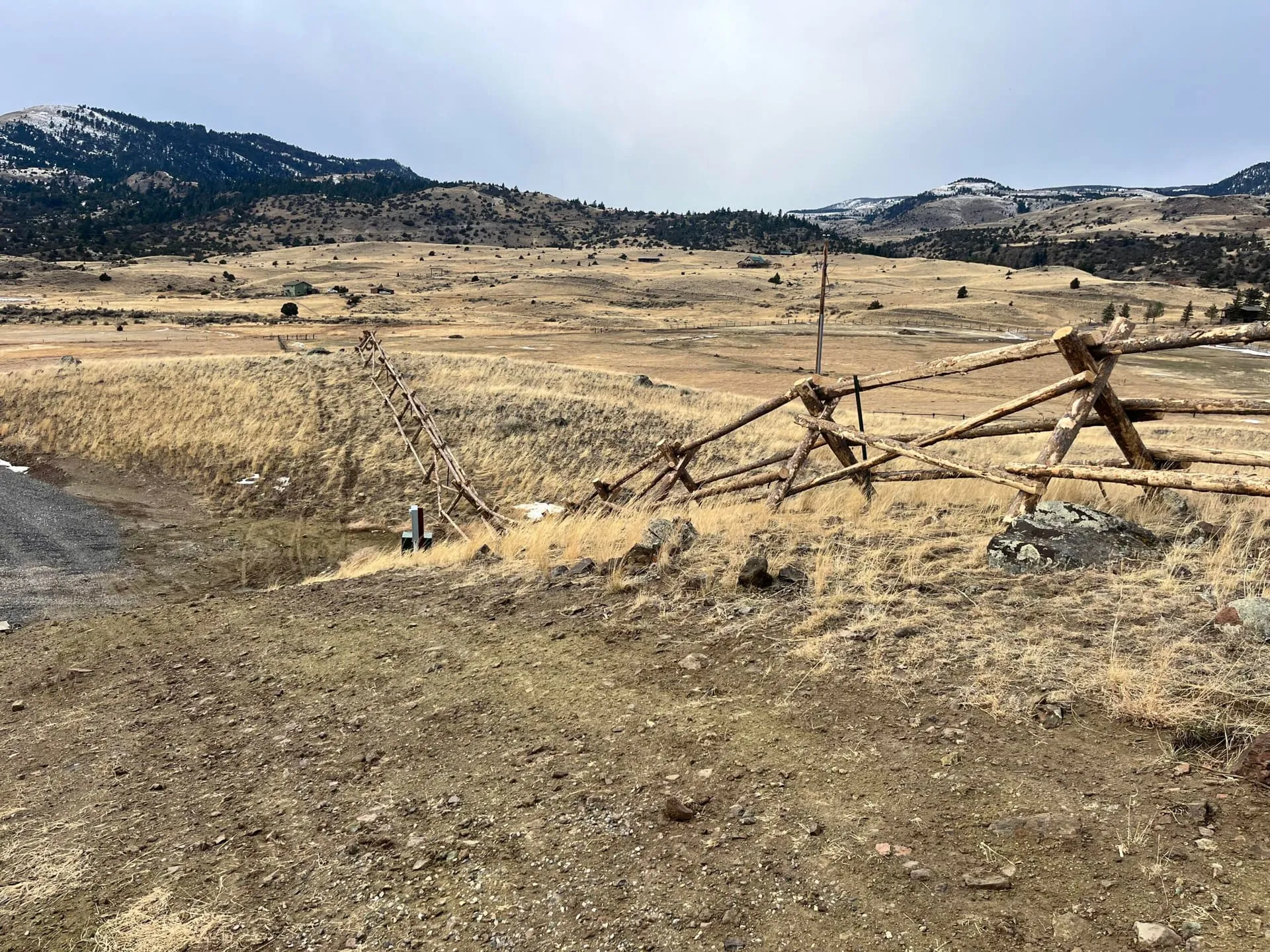 Where a fence meets a road, the ditch, the right-of-way, and the drive crossing all need a plan.
Who builds and maintains a fence between neighbors?
Montana calls these partition fences, and the rules sit in Title 70.
The default split. MCA 70-16-205 says adjoining owners are equally bound to maintain the monuments and fences between them. Unless prescription, custom, or an agreement says otherwise, each owner maintains all fencing to the right of the midpoint of the common boundary line as viewed from the owner’s land. Stand on your side, face the line: the half to your right is yours. Where terrain differs a lot between the two sides, the statute says responsibility is set by mutual agreement, considering factors like cost and time.
Fencing later. An owner can leave land unfenced. Under 70-16-205 and MCA 70-16-207, an owner who later encloses land next to a neighbor’s existing division fence can owe the neighbor a share of that fence’s value.
Repairs and removal. MCA 70-16-209 lets a neighbor give 60 days’ notice that a new fence is needed, or 5 days’ written notice for repairs, then do the work and recover the cost from the party responsible. MCA 70-16-210 requires at least 6 months’ notice before removing your share of a partition fence.
The statutes are the backstop. The better path is a conversation with the neighbor before a replacement starts: which sections each of you owns, who pays for what, whether stock will be on either side during the build, and whether the crew can work from both sides. Put what you agree on in writing.
Should the fence go on the line or inside it?
On the line. The fence is usually shared, which means shared obligations and a neighbor who has a say. It needs a surveyed line, not a guess.
A few feet inside. The fence is yours alone to build, maintain, and replace on your schedule. You give up practical use of the strip outside it, and you still need a way to reach the far side. Fences that sit off the line for decades can also feed disagreements about where the line really is, which is a question for an attorney rather than a fence crew.
Off the line for the ground’s sake. Property lines cross bogs, ledges, and steep sidehills without regard for building. As our fence planning guide explains, sometimes the right fence sits off the line on buildable ground, where the survey and the neighbor allow.
Find the pins first. Survey pins, a recorded certificate of survey or plat from the county clerk and recorder, and a licensed land surveyor when pins are missing are how you locate a boundary. Aerial maps and parcel viewers are not a survey.
What this means when you plan a fence
Before we stake a boundary or frontage fence, these are the questions we want answered:
- Is the parcel open range, inside a herd district, or inside town limits?
- Where exactly is the line, and are the pins found?
- Will the fence be shared, or set inside the line? Has the neighbor agreed in writing?
- What does the fence have to hold? The legal minimum and the right fence for your animals are often different things.
- Where does it meet roads, drives, and gates?
The before-you-build checklist covers the property-line, locate, and access questions, and our guide to measuring your property for a fence estimate covers footage, corners, and photos.
When you’re ready to sketch the line, trace it with the fence line measurer to get footage, corners, and gates in one place, then start a fence estimate or call (406) 551-6772. Free on-site measurements across Southwest Montana.