To keep elk and deer out of a stackyard, garden or orchard in Montana, you fence that one area with tall woven wire, roughly 7 to 8 feet, on solid posts, with the mesh tight to the ground and a gate that stays shut. You don’t fence the whole property. A small, tall, tight enclosure around the thing that’s getting eaten works. A long, medium-height fence around everything mostly gets walked over, pushed through, or snowed under.
Our guide to wildlife-friendly fencing covers the other half of the job, letting animals cross livestock and boundary fence safely. This post is only about keeping them out.
The short answer
- Height: Montana Fish, Wildlife & Parks’ Landowner’s Guide to Wildlife Friendly Fences puts permanent non-electric deer and elk exclusion fence at 7 to 8 feet. For a deer-only garden, MSU research found 6 feet was enough.
- Material: woven wire on wood posts, or wood and steel posts, brought tight to the ground, with a visible top.
- Size: fence the smallest area that does the job, as close to the hay or garden as you can work.
- Gates: in a corner, full height, tight at the bottom, and self-latching.
- Snow: a drift against the fence takes height off it. Plan the height from the snow line, not the ground.
How tall does an elk and deer fence need to be?
It depends on what’s coming and what you’re protecting.
Deer in a garden. MSU Extension’s non-chemical deer control publication reports that research at Montana State University found a 6-foot fence sufficient to keep deer out of a garden, and that woven wire is the best year-round choice where deer pressure is steady.
Elk, or deer and elk together. FWP’s guide sets permanent non-electric deer and elk exclusion fence at 7 to 8 feet. For gardens, orchards and other plots, it says 8-foot woven wire is the more common build.
Stackyards. FWP describes the traditional stackyard fence as woven wire at least 8 feet high. A hard winter is when elk come for the hay, so this is the fence that gets tested hardest.
Those are typical figures from published guidance, not code requirements. Your site decides the final number. A garden in town with occasional deer is a different problem from a stackyard on a winter range where a herd shows up every January.
| What you’re protecting | Typical height in published guidance | Common build |
|---|---|---|
| Vegetable garden, deer only | About 6 ft (MSU research) | Woven wire or welded mesh panels on wood posts |
| Garden or orchard, deer and elk | 7 to 8 ft (FWP) | 8-ft woven wire, wire tight to the ground |
| Hay stackyard | At least 8 ft woven wire, or about 6 to 7 ft permanent electric (FWP) | Woven wire on wood or wood and steel posts |
| Scattered young trees | Varies | Individual cages, or an enclosure if the trees are grouped |
What should an exclusion fence be built from?
Woven wire, not strands. Deer and elk push between wires and go under a bottom wire that sits off the ground. Woven wire closes those gaps. FWP’s guide calls for the wire to be brought tight to the ground. In an MSU study of fences built to keep deer and elk off baited hay, the most consistently effective design for both species was six feet of woven wire, made from two 3-foot rolls stacked and tied together.
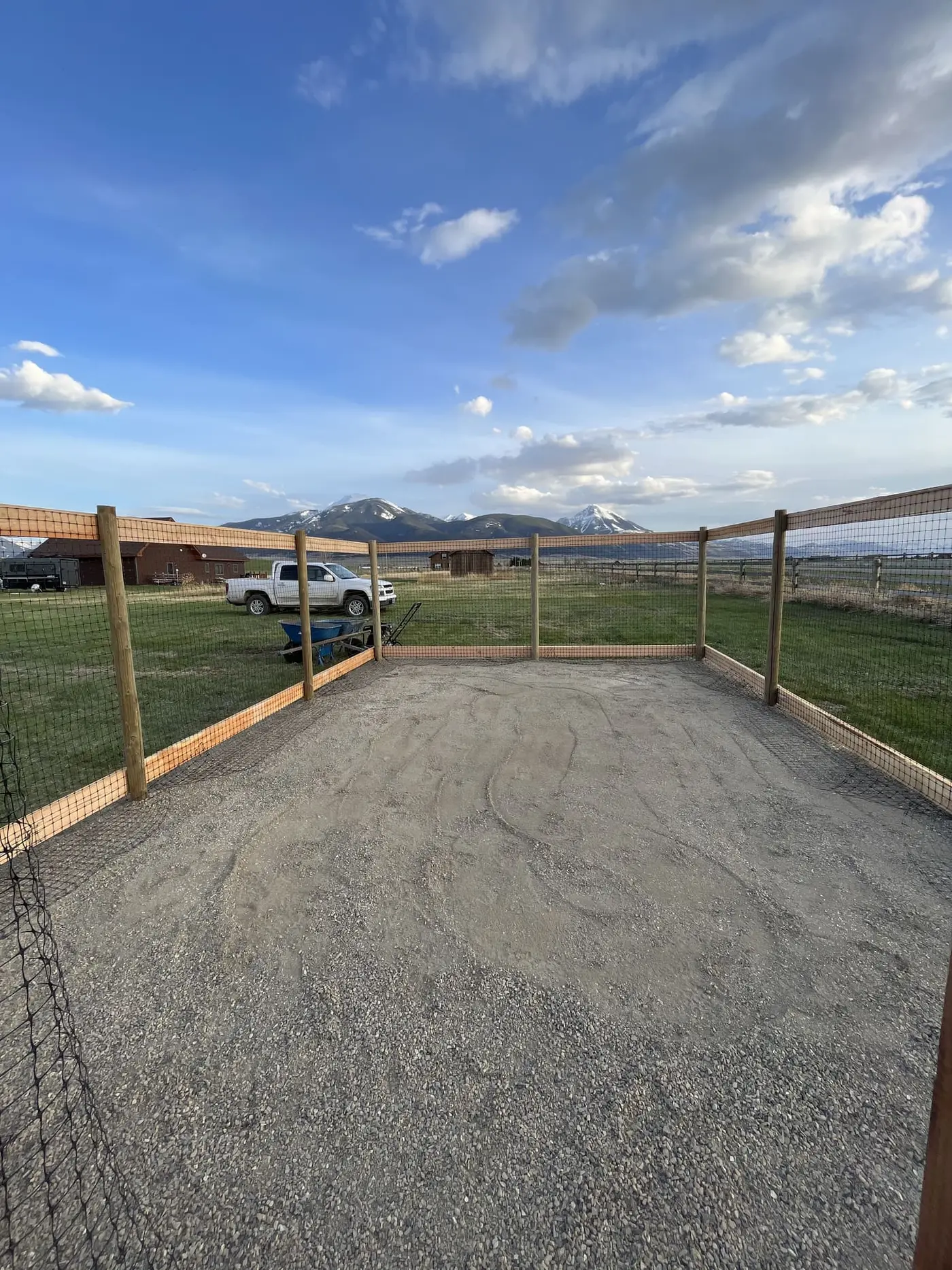
Mesh panels on a frame. For a garden that sits near the house, welded mesh panels in a wood or steel frame give a cleaner look and a tidier edge. Our deer-proof garden enclosure is that kind of build: a black-finished frame with wire mesh panels and raised cedar-and-steel beds inside. The dark frame drops into the hillside from a distance.
Posts. FWP’s guide describes stackyard fence on wood posts or a mix of wood and steel, and garden woven wire on posts spaced roughly 8 to 20 feet apart. Tall fence needs tall posts set deep. An MSU Extension study of fences built to exclude deer and elk notes that typical new 8-foot construction uses 11-foot posts set 36 inches deep. Rock, soil and frost decide the method; our post on how fence posts are set explains the options.
A visible top. FWP recommends making the top of an exclusion fence highly visible with a top rail, high-visibility wire, or flagging. An animal that can see the fence is less likely to hit it.
Electric as an alternative. FWP’s guide also describes a permanent high-tensile electric stackyard fence, about 6 to 7 feet tall, with strands roughly 10 inches apart and alternating hot and ground wires. It works, but it’s a fence you maintain. MSU Extension’s publication on electric fencing for deer and elk calls for regular checks of the voltage, and grass and drifted snow against the wires both cut its effect.
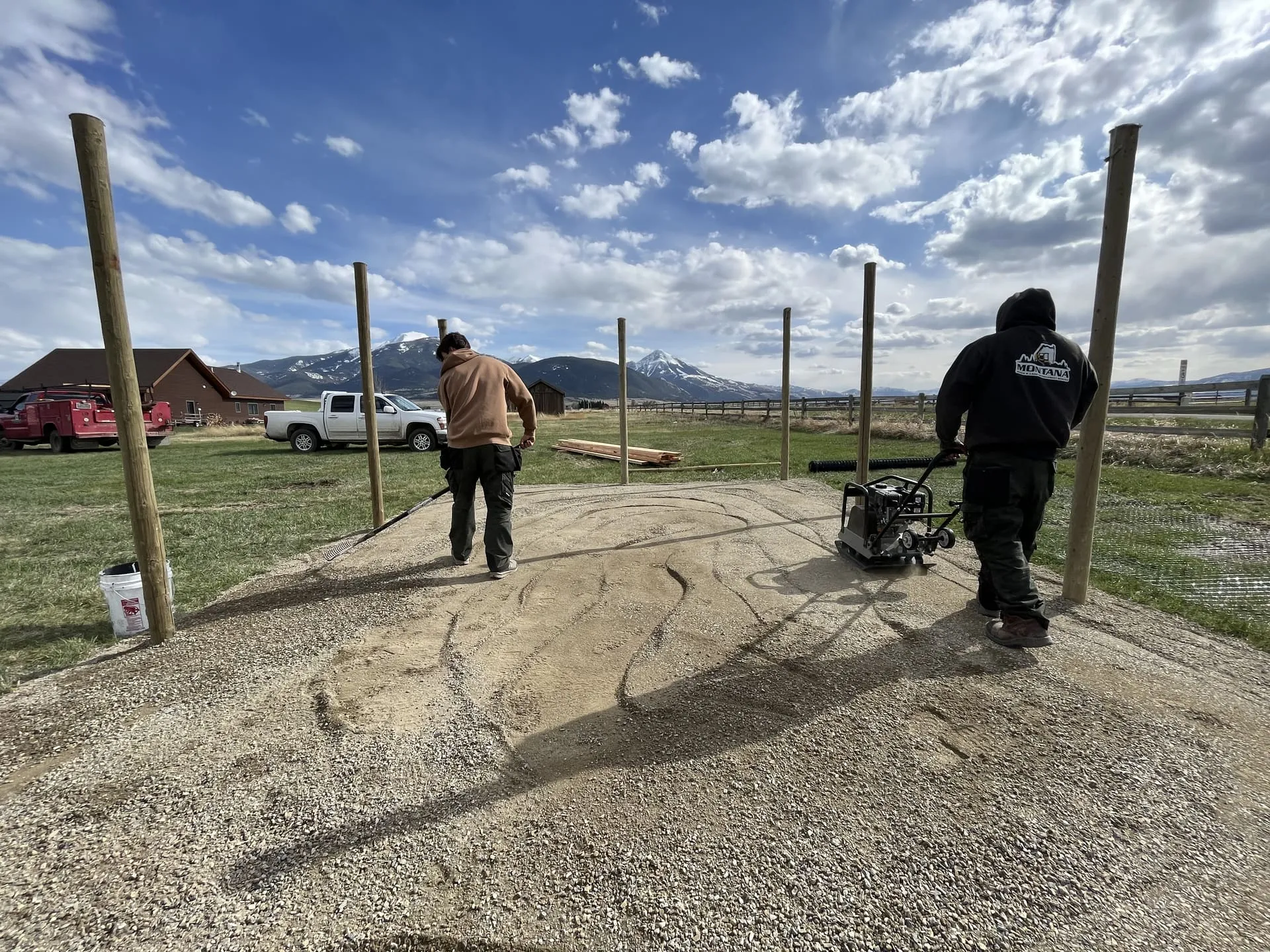 Tall posts go in and the base is finished before any mesh goes on.
Gates that stay shut
A tall fence with a gate left open is decoration. The gate is where most exclusion fences fail.
- Put it in a corner. FWP’s guide recommends corner gates for exclusion fence. An animal that gets inside is more likely to find its way back out through an open corner gate than through one halfway down a side. For stackyards, the guide mentions one-way gates in the corners for the same reason.
- Build it full height. A 4-foot gate in an 8-foot fence is the low spot every animal finds.
- Close the bottom. Keep the gap under the gate as tight as the mesh along the rest of the line, and remember that frost and gravel change that gap over a winter.
- Make it latch on its own. Self-closing hinges or a spring, and a latch an elk can’t nose open. A gate that relies on someone remembering will be open the one night it matters.
- Size it for the equipment. A stackyard gate has to pass the bale truck or the tractor and loader without anyone getting out to wrestle a section of fence.
Tall, heavy gates hang on hinge posts that carry a lot of load. Those posts and the corners need real bracing, which is why corners and braces fail first on a fence like this.
Corners and long pulls
Woven wire only works if it stays tight, and the tension lives in the corners. An 8-foot fence carries more wire and more snow and wind load than a 4-foot one, so its corner assemblies need to be bigger and set deeper. Every gate is a corner too, since each opening ends one stretch and starts another.
Simple shapes help. A square or rectangle around the stack, or around the garden, is four strong corners. A wandering line that follows every bed and tree adds corners and adds places for the mesh to go slack.
Snow drifting over the fence
This is the Montana problem most exclusion fences don’t plan for. A drift on the upwind or downwind side of the fence is a ramp. In MSU’s deer and elk fence study, drifts deeper than 3 feet temporarily knocked sites out of the trial because the effective fence height dropped below 3 feet. An 8-foot fence with 4 feet of drift against it is a 4-foot fence until the thaw.
A few ways to plan around it:
- Before you build, look at where snow piles on that ground in February. Drifts form behind buildings, windbreaks, and other fences.
- Keep the enclosure out of a known drift line where you can, and don’t put a solid wall, a shed or a tight row of trees right beside it.
- Leave a clear strip outside the fence. MSU’s electric fencing publication recommends a 12- to 15-foot open border around a stackyard fence so animals can see the wire, and that strip also gives you room to plow drifts away.
- Keep the hay back from the fence so nothing can reach over or lean in.
Why you fence the small area, not the whole property
FWP’s guide is direct on this: if you need exclusion fence, keep it on small areas for specific purposes, such as gardens, beehives, calving areas or haystacks, close to the thing being protected, and leave the rest of the property open to wildlife.
There are practical reasons too. The length of fence grows with the size of what you enclose. A stackyard or garden might be a few hundred feet around. The whole place might be miles. Every foot of 8-foot game fence is more wire, taller posts and more corners to keep tight. A big enclosure also cuts animals off from winter range and travel routes, so they end up testing the fence all along its length instead of walking past one small yard.
The usual layout on Gallatin and Park County properties is tall exclusion fence around the hay, the garden and the orchard, and ordinary wildlife-tolerant fence everywhere else.
FWP help for stackyards
Montana Fish, Wildlife & Parks runs a Game Damage Assistance Program. FWP lists temporary or permanent stackyard fencing among the help it may provide, along with hazing, repellents, and damage hunts. Landowners may be eligible if they allow public hunting during established hunting seasons. Damage is reported to the local game warden, an FWP biologist, or the FWP regional office.
Eligibility and what’s offered can change, so call your FWP regional office before you plan around it. This isn’t legal advice.
Before you build
- What exactly is getting damaged, and when? Winter hay, summer garden, and young trees each call for a different enclosure.
- Is it deer only, or elk too?
- Where does snow drift on that ground?
- What equipment has to get through the gate?
- How small can the enclosure be and still work for you?
You can outline the enclosure and get its perimeter with our fence line measurer. When you’re ready, start a fence estimate or call (406) 551-6772 and we’ll walk the site with you, drift lines included.